All articles
Puja Vidhi
Oct 11, 2026
Havan
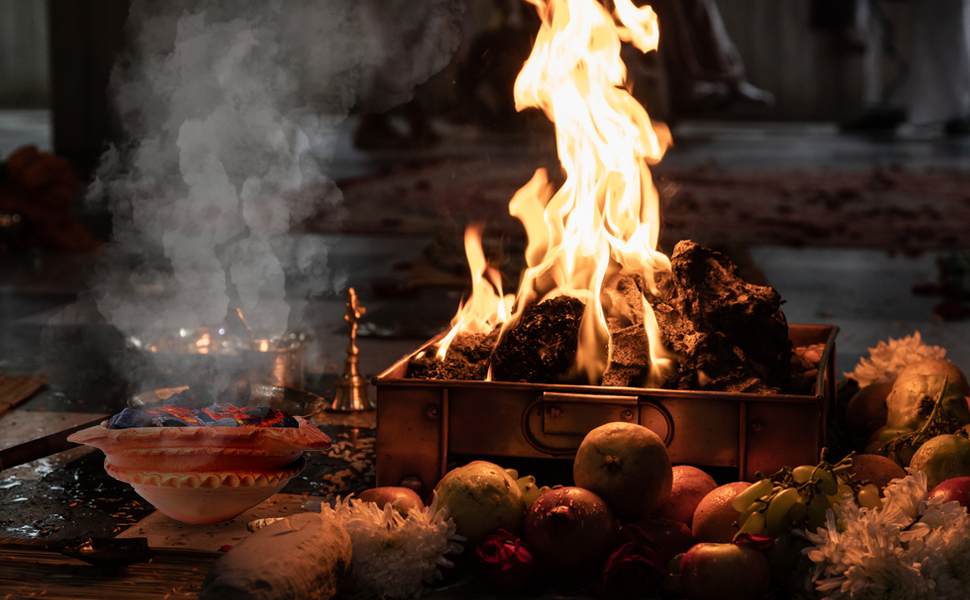
Havan, an ancient Vedic ritual, is a sacred fire ceremony performed to invoke divine energies and purify the mind, body, and surroundings. Central to Hindu spiritual practice, it involves offering various natural substances such as ghee, herbs, and grains into the fire while chanting mantras. Each element symbolizes a specific aspect of life—purity, prosperity, and spiritual growth—and the fire acts as a medium to transform these offerings into positive energy.
Scientific studies have shown that havan can have profound psychological and physiological benefits. The aromatic smoke, derived from herbs and resins, acts as a natural disinfectant, while the rhythmic chanting reduces stress and promotes mental clarity. Beyond personal well-being, havan fosters a sense of community and spiritual connection when performed collectively. In essence, this timeless ritual bridges the material and spiritual worlds, bringing harmony, protection, and positivity into our lives.
Havan: The Science Behind the Ancient Fire Ritual
---
Introduction
Havan (also called Homam or Yajna) is a sacred fire ritual central to Vedic traditions. Fire is
considered a purifier, a medium to convey offerings to deities, and a symbol of divine energy.
While traditionally regarded as a spiritual practice, modern science shows that Havan has
physiological, environmental, and psychological benefits. Many aspects that were once
considered purely ritualistic now have measurable scientific explanations.
---
1. The Symbolism of Fire in Havan
Fire (Agni) represents energy, transformation, and purification.
Ancient texts describe Agni as the carrier of offerings to the divine, but also as a cleansing agent
for the surrounding environment.
Modern research confirms that controlled combustion of certain herbal mixtures during Havan
releases beneficial compounds, while reducing pathogens in the air.
---
2. Medicinal Smoke: The Science of Havan Samagri
Havan samagri consists of herbs, ghee, wood, and spices like sandalwood, camphor, and
neem.
When burned, these substances release volatile compounds with antiseptic and antimicrobial
properties.
Uncommon fact: Studies show that Havan smoke can reduce airborne bacteria and fungi, acting
as a natural disinfectant, especially in enclosed spaces.
---
3. Air Purification
Havan rituals often include continuous low-intensity fire, which produces negative ions.
Negative ions are known to improve air quality, reduce allergens, and enhance mood.
Ancient practitioners may not have understood the chemistry, but they observed that Havan
cleanses the environment, a fact now supported by environmental studies.
---
4. Physiological and Psychological Benefits
Chanting mantras during Havan promotes deep breathing, which reduces stress, lowers heart
rate, and improves lung function.
Observation of fire induces relaxation and mindfulness, triggering alpha brain waves associated
with meditation and calmness.
Lesser-known insight: The combination of mantra, firelight, and aroma creates a multi-sensory
experience that engages the brain and promotes mental clarity.
---
5. Spiritual and Neurological Effects
The repetitive chanting of mantras during Havan entrains brain rhythms, leading to
synchronized neural activity and a meditative state.
Havan can increase the release of dopamine and serotonin, enhancing mood and sense of
well-being.
Group Havans amplify these effects via social bonding and collective focus.
---
6. Havan and Environmental Harmony
Ancient texts emphasized that Havan balances natural elements (earth, water, fire, air, ether).
Modern interpretations suggest that controlled fire and herbal combustion can reduce indoor
pollutants and promote a healthier micro-environment.
Certain herbs used in Havan, like camphor and neem, also have insect-repellent and anti-fungal
properties.
---
7. Havan and Thermal Comfort
In cold climates, the warmth of a Havan fire improves thermal comfort, which may have
historically facilitated prolonged community gatherings and rituals.
The firelight also has a psychological effect, creating a sense of focus and presence, enhancing
the ritual’s meditative impact.
---
8. Havan as a Community Practice
Beyond individual benefits, Havan fosters social cohesion, as families and communities gather,
chant, and participate together.
This collective activity strengthens emotional bonds, improves cooperation, and supports
cultural continuity.
---
9. Lesser-Known Knowledge
Some studies suggest that specific herbal combinations in Havan samagri may release
phytoncides, compounds known to improve immunity and reduce stress.
Ancient practitioners recommended Havan near rivers or open spaces, which now aligns with
modern environmental science for optimal smoke dispersion and safety.
The timing of Havan, often at sunrise or sunset, coincides with periods of maximum atmospheric
ionization, which may enhance its calming and purifying effects.
---
Conclusion
Havan is not merely a ritual—it is a holistic practice integrating spirituality, environmental
hygiene, mental wellness, and community bonding. Ancient Vedic practitioners intuited the
purifying and health-promoting effects of fire, herbs, and mantra long before modern science
confirmed them. Today, Havan stands as a unique bridge between tradition, psychology, and
environmental science, showing that devotion and empirical benefits can coexist harmoniously.
Book experienced pandits online for all Hindu puja rituals with Bhaktinama – simple, reliable, and authentic.