All articles
Ritualistic Worship
Oct 11, 2026
Kanya Pujan / Kanjak Pujan
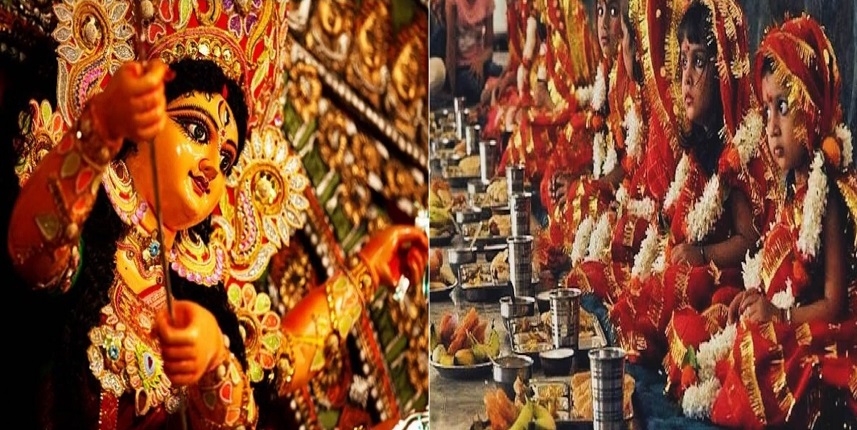
Kanya Pujan, also known as Kanjak, is one of the most sacred rituals performed on the eighth (Ashtami) or ninth (Navami) day of Navratri. On this day, young girls—considered embodiments of Goddess Durga’s nine forms—are worshipped with utmost devotion. Their feet are washed, tilak is applied, and they are offered traditional prasad such as puri, chana, and halwa. This ritual is not just about tradition; it is a reminder that divinity resides in innocence and purity. By honoring these young girls, devotees express gratitude to Maa Durga for her strength, protection, and blessings. Kanya Pujan beautifully symbolizes respect for womanhood and the power of the feminine energy that sustains the universe.
🌸 The Significance of Kanya Pujan in Hindu Tradition
Introduction
Kanya Pujan, also known as Kumari Pujan or Kanjak Pujan, is one of the most sacred rituals
performed during Navratri—especially on the eighth (Ashtami) or ninth (Navami) day. This ritual
involves worshipping young girls (usually between the ages of 2 and 10) as manifestations of
the nine forms of Goddess Durga (Navadurga). In Hindu belief, the feminine energy or Shakti
resides in every girl child, making Kanya Pujan a symbolic way of honoring Devi’s power, purity,
and blessings.
---
Mythological Background
The roots of Kanya Pujan are found in Hindu scriptures:
According to Devi Mahatmya (part of Markandeya Purana), Goddess Durga is the ultimate
source of energy who manifests in different forms to defeat demons and restore cosmic
balance. The nine forms (Shailputri, Brahmacharini, Chandraghanta, Kushmanda, Skandamata,
Katyayani, Kaalratri, Mahagauri, Siddhidatri) are celebrated during Navratri.
Worshipping young girls is believed to be equivalent to worshipping the Goddess herself, as
each girl represents one form of the divine feminine.
In the Mahabharata, before the great war of Kurukshetra, Lord Krishna performed Kumari Pujan
to invoke divine blessings for victory.
---
When is Kanya Pujan Performed?
Typically on Maha Ashtami (Durga Ashtami) or Maha Navami during Navratri.
In some regions, families perform it on both days.
The ritual is especially popular in North India (Uttar Pradesh, Punjab, Haryana, Himachal
Pradesh, Bihar), though it is practiced across India with slight variations.
---
Rituals of Kanya Pujan
1. Inviting the Kanyas
Families invite 9 young girls (representing the nine forms of Durga) and often include a boy
(called Langura, symbolizing Bhairav, the protector of the Goddess).
2. Washing of Feet
Traditionally, the feet of the girls are gently washed as a mark of reverence, symbolizing the
cleansing of negativity and welcoming of divinity.
3. Tilak and Puja
A red tilak is applied on their foreheads.
The girls are offered flowers, incense, and prayers, invoking them as the living embodiment of
Devi.
4. Offering Prasad and Food
Special food is prepared, often including poori, chana (black chickpeas), halwa—considered
favorite of Goddess Durga.
The girls are served with love and respect.
5. Gifts and Dakshina
At the end, the devotees offer small gifts such as bangles, ribbons, toys, money, or clothes as a
token of gratitude and blessings.
---
Symbolism of Kanya Pujan
Purity & Innocence – Young girls symbolize untouched, pure energy.
Shakti (Power) – Each kanya is an embodiment of the Goddess’s strength and divine feminine
energy.
Equality & Respect – It emphasizes the importance of respecting women and girls in society.
Gratitude – Devotees acknowledge the divine force that nurtures and sustains creation.
---
Scientific & Social Perspective
While the ritual is deeply spiritual, it also carries scientific and cultural relevance:
Psychological Impact – Girls feel valued, respected, and cherished, which boosts their
self-worth.
Community Bonding – The tradition strengthens social ties, as families visit one another and
honor each other’s children.
Nutritional Offering – The food offered (chana, poori, halwa) is balanced with proteins, carbs,
and fats, providing wholesome nourishment.
Symbol of Gender Equality – At its core, the ritual reminds society of the divine feminine’s
presence, encouraging respect for girls and women.
---
Regional Variations
In West Bengal, instead of Kanya Pujan, the focus is on Kumari Puja, where a girl is worshipped
as the living Durga during Durga Puja celebrations.
In South India, similar reverence is shown during Kumari Pooja in Devi temples.
In Nepal, young girls are even enthroned as Kumari Devi, living goddesses believed to carry
Durga’s spirit.
---
Kanya Pujan is not merely a ritual but a reminder of the sacred feminine energy that sustains
the universe. By worshipping young girls, devotees honor Goddess Durga in her purest form
and seek her blessings for health, prosperity, and spiritual growth. At the same time, it carries a
profound social message—that every girl is divine and must be respected and valued in society
Book experienced pandits online for all Hindu puja rituals with Bhaktinama – simple, reliable, and authentic.