All articles
Spirituality
Oct 11, 2026
Hindu cosmology
Discover the fascinating world of Hindu cosmology, from Brahmanda and Yugas to multiple universes and cosmic cycles. Explore how ancient Hindu scriptures offer profound insights that invite comparisons with modern cosmology.
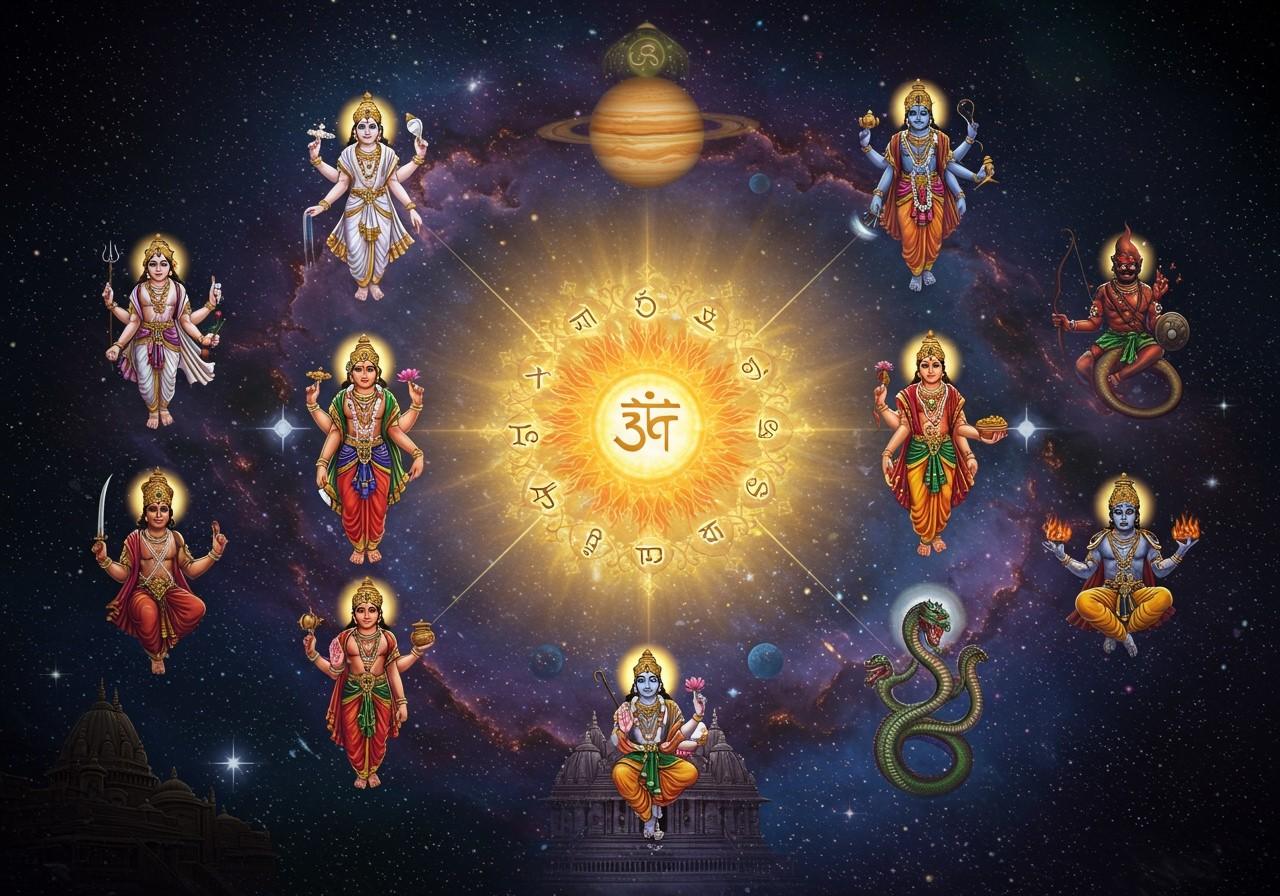
Long before modern astronomy began exploring galaxies, cosmic expansion, and the origins of the universe, the sages of Sanatan Dharma contemplated the nature of existence through deep meditation and spiritual inquiry. Their insights, preserved in the Vedas, Upanishads, and Puranas, gave rise to one of the world's most profound cosmological systems—Hindu Cosmology.
Rather than describing the universe as a one-time creation, Hindu cosmology presents reality as an eternal cycle of creation, preservation, dissolution, and renewal. While these teachings are primarily spiritual and philosophical, many of their concepts invite fascinating comparisons with ideas discussed in modern cosmology and theoretical physics.
Whether viewed through the lens of faith, philosophy, or curiosity, Hindu cosmology encourages us to see ourselves as an inseparable part of an infinite and intelligent universe.
To deepen your understanding of these timeless teachings through authentic Vedic traditions, Bhaktinama offers online pandit booking, Vedic pujas, temple rituals, astrology consultations, and online donation services, helping devotees stay connected with Sanatan Dharma wherever they are.
The Universe as a Living Consciousness
In Hindu philosophy, the universe is not considered a lifeless collection of matter. Instead, it is viewed as a living manifestation of Brahman, the ultimate universal consciousness. Creation, preservation, and dissolution occur continuously as part of an eternal cosmic rhythm.
The concept of Brahmanda, or the Cosmic Egg, symbolizes the origin of the universe from a single divine source. Ancient scriptures describe creation emerging from the unmanifest before expanding into the visible cosmos.
The Rig Veda refers to Hiranyagarbha, the "Golden Womb" or "Golden Embryo," as the source of creation. Although this should not be interpreted as a scientific description of the Big Bang, many scholars and readers find the imagery of a radiant cosmic beginning to be an intriguing symbolic parallel.
This spiritual understanding reminds us that the universe is not separate from the Divine but is itself an expression of divine consciousness.
Through Bhaktinama, devotees can participate in authentic Vedic rituals and spiritual practices that honor the cosmic order described in Hindu scriptures, bringing ancient wisdom into modern life.
The Cycles of Time: Understanding the Yugas
Unlike many traditions that view time as linear, Hindu cosmology presents time as cyclical. Every universe moves through repeating ages known as Yugas, reflecting both cosmic evolution and the gradual transformation of human consciousness.
The four Yugas are:
Satya Yuga – The Age of Truth and righteousness.
Treta Yuga – Virtue remains strong, though decline begins.
Dvapara Yuga – Dharma weakens as conflict increases.
Kali Yuga – The current age, marked by materialism, ignorance, and spiritual decline.
Together, these four Yugas form one Maha Yuga, lasting approximately 4.32 million human years. According to Hindu scriptures, a thousand Maha Yugas constitute one day of Lord Brahma, followed by an equally long night before creation begins again.
Interestingly, modern cosmology also explores models in which the universe experiences long-term cycles of expansion and transformation. Although these scientific theories differ fundamentally from Hindu scripture, both perspectives encourage reflection on the immense scale of cosmic time.
For devotees observing special occasions related to the Yugas or performing spiritual remedies during Kali Yuga, Bhaktinama offers online puja booking and experienced Vedic pandits for authentic Hindu ceremonies.
The Concept of Multiple Universes
One of the most fascinating ideas found in Hindu cosmology is the existence of countless universes, known as Brahmandas. Scriptures such as the Bhagavata Purana describe innumerable universes, each with its own cycle of creation and its own governing deities.
The Yoga Vasistha poetically states that countless universes arise and dissolve like bubbles upon the ocean, emphasizing the limitless nature of creation.
Modern theoretical physics has proposed concepts such as the Multiverse Theory, which suggests the possible existence of multiple universes. While the scientific multiverse remains hypothetical and differs significantly from the spiritual descriptions found in Hindu texts, the conceptual similarity continues to fascinate scholars, philosophers, and spiritual seekers alike.
The infinite vision presented in Hindu scriptures inspires humility, reminding us that creation extends far beyond the limits of ordinary perception.
To celebrate these sacred teachings through scripturally guided rituals, Bhaktinama provides online pandit services, Vedic ceremonies, and astrology consultations rooted in authentic Hindu tradition.
Brahma's Day and the Cosmic Timeline
The Vishnu Purana presents one of the most extraordinary descriptions of cosmic time.
According to Hindu tradition:
One day of Lord Brahma equals 4.32 billion human years.
One night of Lord Brahma also lasts 4.32 billion years.
Creation unfolds during Brahma's day and rests during Brahma's night.
After Brahma completes one hundred celestial years, the universe undergoes Maha Pralaya, the Great Dissolution.
These immense timescales demonstrate how ancient Hindu thinkers imagined the universe on a truly cosmic scale. Although these values arise from religious cosmology rather than scientific measurement, many readers find it remarkable that Hindu scriptures envisioned billions of years long before modern geology and astronomy developed similar scales for understanding Earth's history and the age of the universe.
Through Bhaktinama, devotees can perform Vedic rituals dedicated to Lord Vishnu, Lord Brahma, and other deities while preserving these ancient cosmological traditions.
The Three Cosmic Forces (Triguna)
Hindu philosophy explains that all creation functions through three fundamental qualities known as the Trigunas:
Sattva represents purity, harmony, wisdom, and balance.
Rajas symbolizes activity, desire, ambition, and transformation.
Tamas signifies inertia, darkness, rest, and dissolution.
Rather than physical substances, these Gunas are philosophical principles that influence nature, the mind, and human behavior. Every individual contains all three qualities in varying proportions.
Some modern writers compare the interaction of the Trigunas with the balance found in natural systems. While these comparisons are symbolic rather than scientific, they illustrate how Hindu philosophy sought to explain the dynamic balance underlying all existence.
For those seeking spiritual balance, Bhaktinama offers personalized Vedic pujas, meditation-oriented rituals, and guidance from experienced pandits according to traditional Hindu practices.
The Universe Within the Human Being
One of the deepest teachings of Hindu cosmology is the principle that the macrocosm and microcosm reflect one another. The same universal order that governs the cosmos also exists within every individual.
Many spiritual traditions within Hinduism associate the seven higher realms (Lokas) with the awakening of consciousness through the seven Chakras. Likewise, sacred symbols such as Akash Ganga (the celestial Ganga) and the primordial sound Om represent the intimate relationship between the universe and spiritual consciousness.
Some contemporary writers compare the symbolism of Om with modern discussions about cosmic vibrations or the universe's earliest observable signals. These comparisons should be understood as philosophical analogies rather than direct scientific equivalences.
The central message remains timeless: by understanding ourselves, we begin to understand the universe.
Through meditation, mantra chanting, and authentic Vedic rituals available on Bhaktinama, devotees can deepen this inner spiritual journey under the guidance of qualified priests.
Ancient Concepts and Modern Scientific Parallels
Although Hindu cosmology is fundamentally spiritual rather than scientific, several concepts invite thoughtful comparison with modern ideas:
Hiranyagarbha symbolizes a cosmic origin, inviting comparison with discussions about the universe's beginning.
Cycles of Creation and Pralaya resemble philosophical discussions surrounding cyclic universe models.
Maya encourages reflection on the relationship between perception and reality, a topic explored in both philosophy and modern physics.
Sacred sound and vibration remind us that vibration plays an essential role in both spiritual traditions and scientific understandings of waves and energy.
These parallels should be appreciated as inspiring similarities rather than proof that ancient scriptures predicted modern scientific discoveries. Their enduring value lies in encouraging curiosity, contemplation, and respect for both spiritual wisdom and scientific exploration.
Along with online puja services and scripturally guided ceremonies, Bhaktinama also offers the Endless Surya Hawan, a continuous Vedic fire ritual dedicated to Lord Surya. As the Sun represents the source of light, life, and cosmic order in Hindu tradition, this sacred Hawan is a meaningful way for devotees to seek spiritual strength, health, and divine blessings while honoring one of creation's most revered celestial forces.
Conclusion
Hindu cosmology offers one of humanity's most expansive visions of the universe. It portrays existence as an eternal dance of creation, preservation, and dissolution, governed by divine intelligence and infinite consciousness.
Whether exploring the vast cycles of the Yugas, the idea of countless universes, or the philosophical meaning of Brahmanda, these ancient teachings continue to inspire seekers across the world. While science and spirituality approach the universe in different ways, both encourage humanity to ask deeper questions about existence and our place within it.
As the Yoga Vasistha beautifully expresses:
"As countless bubbles arise and disappear upon the ocean, so too do innumerable universes emerge and dissolve within the infinite consciousness."
To continue your own spiritual exploration, Bhaktinama offers online pandit booking, authentic Vedic pujas, astrology consultations, temple donations, and the sacred Endless Surya Hawan, helping devotees celebrate Sanatan Dharma with faith, authenticity, and convenience.